The following commentary was in response to Sierra Leone’s trade minister Mr. G.B. Kawusu Konteh, who urged trade inspectors to enforce the law to combat the escalation of prices of essential commodities such as rice and petrol. Wednesday, May 22, 1985 ( The Globe newspaper, Sierra Leone)
It would appear that trade inspectors have outlived their usefulness in Sierra Leone, judging by their ineffectiveness. If they were not working within a system in which nobody is in charge, they would have been declared redundant several years ago.
Their retention in the face of non-profitability adds one more bleak chapter to a discredited regime.
The role of trade inspectors is arguably to seek the interests of the masses vis-a-vis the petty and big-time traders who are by and large the exploiting classes. The decision by the ministry of trade and industry to once more issue public notices stipulating prices of fuel, rice, and other commodities reproduced elsewhere in this issue is most welcome.
The government has designated certain goods as essential commodities which in essence are vital to the survival of the people. It is public knowledge, however, that the trade inspector, from a position of financial weakness, is forever bought over by the trader whose activities are inspected.
It is rather too late in the day for Mr. Kawusu Konteh, who has held his present ministerial post for over one year, to rail at his men for failing to enforce the law. The statements of the minister in this regard could only be taken with the insincerity they deserve.
Hypocrisy by our leaders has become an entrenched institution in this unfortunate land and neither Mr. Kawusu Konteh nor his so-called inspectors of nonentity could alter its size or burgeoning scope.
The people have to reckon with the real facts of life that only by banding together and acting as one in their respective areas under the leadership of genuine parliamentarians or other local heads, could they stem the tide of our inhuman inflation.
Under the present fortuitous circumstances in which our trade inspectors find themselves, they can only show a change of attitude for the worse.
Mr. Kawusu Konteh’s broom is too old to sweep clean.
The Power of Words. At The Tablet Newspaper, the words encapsulating our belief were:
One of several editorials while acting editor of The Globe newspaper (Sierra Leone), May 4, 1985, which captured the attention of the American Embassy in Freetown, and I eventually landed a job at the Voice of America(VOA).
It will be 40 years next month since a virtually unknown Master Sergeant Samuel K. Doe seized power in Liberia in a bloody coup. His end was no less bloody.On his visit to the White House, President Ronald Reagan greeted him as Chairman Moe. Reagan did not care to know the name of his guest.
It was the former president of Liberia William Tolbert, who once said, “I will raise the Liberian people from mats to mattresses.” The meaning of his utterance had scarcely been realized when he was killed by a group of soldiers led by the then 28-year-old, Master Sergeant Samuel Kanyon Doe.
Along with him, thirteen of the people who had wielded political, economic and social power for 33 years under the banner of an autocratic setup, that was the True Whig party, were executed within ten days at the Barclay Training Center.
Though the Master Sergeant was known to lack adequate background to political education, he was received with open arms by his people mainly because he had brought an end to an overfed regime. On April 12 this year, as the sergeant cum commander’s voice came blaring on the air with messages to mark the fifth anniversary of his regime, the Liberian people had little to be pleased with, concerning the state of affairs in their country.
Master Sergeant Doe at 28
Reasons for this are not far-fetched. Personality and ideological conflicts among the top brass of the revolution appeared. Patriotic and conscious Liberians like Dr. Togbana Tipoteh and Boima Fahnbulleh were fired from office. Of late, a spate of arrests has been the commander’s pastime. In June last year, he ordered the arrest of the editors of The Daily Observer and The New Liberian. Later, because of an alleged coup plot, Mr. Doe arrested his main political opponent connected with the forthcoming election.
These and more have engendered resistance and raised some skepticism in Master Doe’s intention for Liberia. Compounding this situation, was his call on all cabinet ministers who may want to contest the November elections, to resign from their posts while he(Doe) retained his. What an autocratic act! Forgetting that the people are tired of rhetoric and are more concerned with reality, the commander keeps paying lip service by saying that he will improve the economy before July this year. Has he walked into an Aladdin Cave? Is it possible for him to come about this within so short a time when he could not salvage the economy with five years in hand?
If it is Sergeant Doe the people of Liberia want as a leader, we shall soon know in the November elections. And if a democratic handover to civilian rule would come to pass, Master Doe would have done a hero’s job. The world will judge the Liberian system by its content, for “it is not difficult to distinguish between systems which have the distinctive characteristics of democracy from those who do not because democracy is a term which determines content.”
The jury is not out because the verdict is clear. Colonialism was bad for Africa. Studies after studies point fingers at the corruption, low economic productivity, and violence which engulfed Africa after independence, to have directly emanated from the colonial and geopolitical system. The legacy of colonialism is disruption. Its cut into cultures like a knife in a cake, with imaginary lines, was devastating.
Racism, political repression, and economic exploitation are enough reasons to damn colonialism.
The crux here, however, is the knowledge and power in the lower and middle Senegal River valley wielded by Muslim mediators in the colonial period between 1850 and 1920, that is under examination. Tamba M’Bayo has not merely glossed over the roles of these translators because they run the gamut. They were “cultural brokers, emissaries, diplomatic hosts, military and expedition guides, treaty negotiators,” and not mere translators.
He contends that the interpreters “occupied a vantage point as transactional go-betweens to manage information between the French authorities and Africans.” He disputes erroneous claims of disloyalty, dishonesty and untrustworthy behavior, attributed to them. Those who work for foreign entities have often been viewed as traitors, sellouts or collaborators, for which there is a price to be paid. Their safe seats were contingent upon the extent of their role, nuanced by the understanding that they wisen-up to any scheme therein.
“For the Muslim interpreters, the situation posed a serious dilemma to the extent that supporting the aspirations of their community and simultaneously fulfilling their obligations to their French employers had the potential of conflict of interest,” argues M’Bayo. He admits upfront, the absence of women in this study, because there were none in the roles in question, in the region of study. No surprise here.
The quality of this enormous account is only eclipsed by the standard of presentation, which takes a complex and controversial topic and makes it easier to grasp. There are five chapters in this book, each with a conclusion and some notes. He provides ten pages of epilogues, five in appendices, ten in bibliographies, seven in indices and a ten-page preface.
Do not cheat yourself by reading the conclusion of each chapter only and conclude you have read this work because each page is not only informative but very educative.
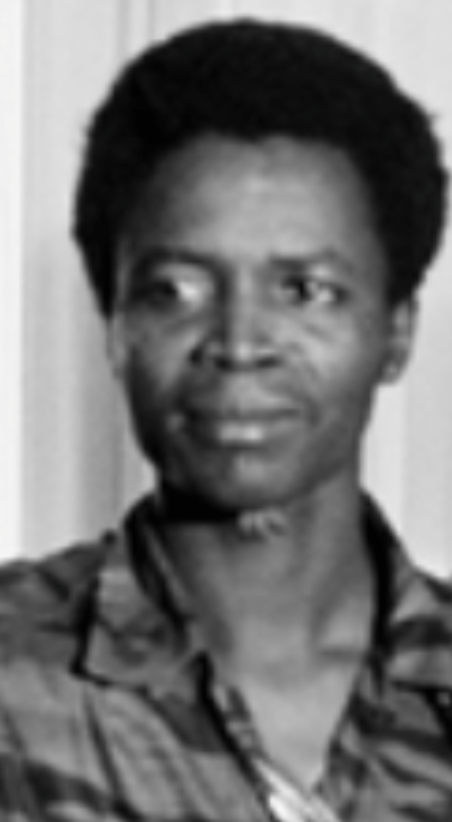
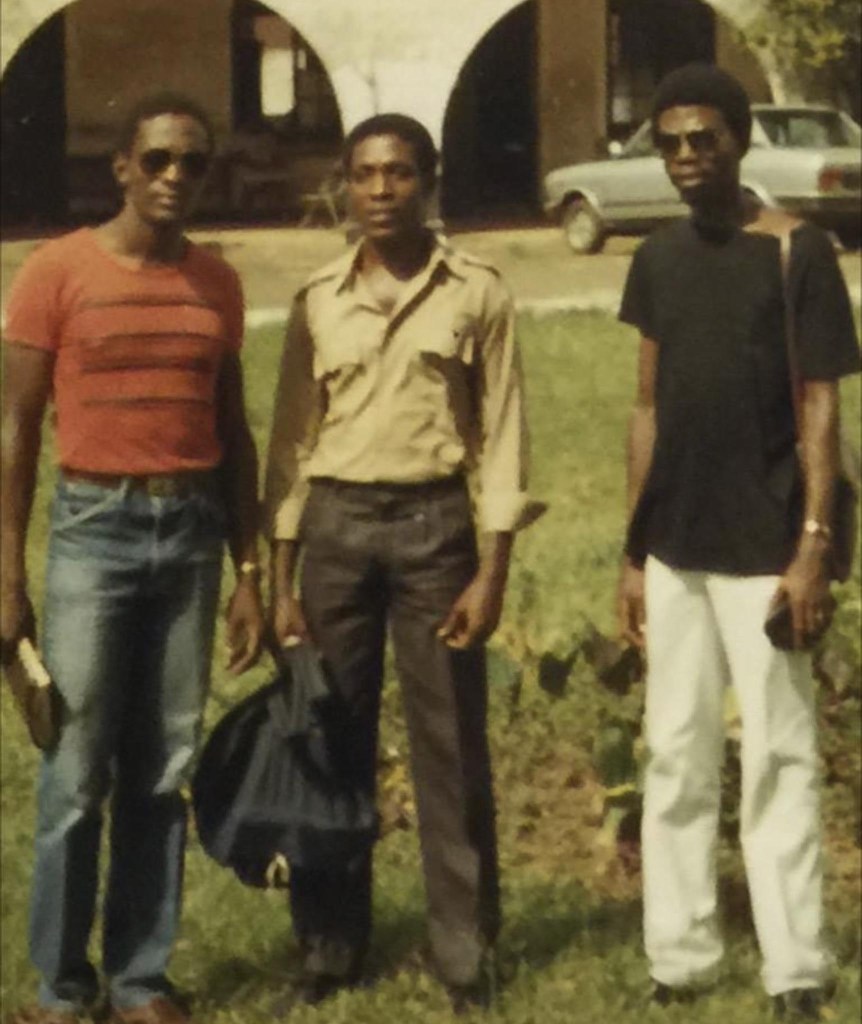
Dr. Tamba M’Bayo (Left Side) @ The Prince of Wales School, Freetown, S.L., 1985.
M’Bayo is a US Fulbright scholar, a polyglot who has worked, traveled extensively in West Africa and an associate professor of history at West Virginia University.His current research is on factors that influence disease eruptions in Sierra Leone.
The marketplace of ideas can be traced to the writings of John Stuart Mill and John Milton. Fred S. Siebert wrote that “Milton was confident that truth was definite and demonstrable, that it had a unique power of survival when permitted to assert itself in a free and open encounter.”
And he pointed out that John Stuart Mill believed that, “the only way in which a human can know a whole of the subject is by hearing what can be said about it by persons of every variety of opinion.”
In a nutshell, this is the self-righting process, the marketplace of ideas, which is a favorite justification for protecting free speech. It promotes the idea that ultimately, whatever good is desired, is better reached by the free trade of ideas, just as with commodities in the open market. The better good will do well in a healthy competition.
If you have been writing down the number of lies the US president tells per day, you are out of paper by now, but here are two standouts.
In spite of Donald Trump’s administration’s lie that his 2017 crowd size at his inauguration dwarfed Barack’s of 2009, the evidence shows otherwise. The world now knows the country of Mexico will not pay for Donald Trump’s wall on the US southern border. It was a lie. Mexico used expletives to describe the wall.
The fact is, because of the free dissemination of ideas, a process gets created in which the truth competes and eventually wins out over falsehood, even if you choose to call falsehood “alternative fact.” There is no such thing. A lie is a lie. The sooner any administration understands liars are losers because the truth wins, the better it can govern.
The idea of the First Amendment jurisprudence complements this thought that the ultimate good sought is better reached by free trade in ideas – that the best test of the truth is the power of the thought to get itself accepted in the competition of the marketplace, which the United States media provide.
The Media are invaluable
Calling the media “the enemy of the people,” does not alter lies about inauguration crowd size or that Americans, not Mexico will have to pony up money for the fulfillment of a campaign promise of a wall, does it? The liar obviously, is the enemy of the people. In this case, the president of these United/Divided States.
There is active competition in the media, with each fighting for high ratings but more attention has obviously been given to ad proceeds and getting the story right is a given for most (excluding Fox News.) The American press comes in many forms with independent ownership.
A true story reduces the public’s difficulty in making the decision about which of what is said and written to agree with and which analyst is deemed the most credible.
How do you tell a true story? If a report says the earth is round, you know it is true because the alternate fact(falsehood) should be, the earth is flat and that’s a lie.
This marketplace can be crazy and incorrect. If so, why should everyone not agree to the same thing? Another burning question is, once the truth is reached, why is there any need to encourage any number of dissenting views? A clear example is hate speech. Why tolerate hate speech when it is so evident that it is wrong?
This could explain why university students make no apologies for shouting down hate speakers and in some cases, outrightly have them disinvited after protests, for views not aligned with the civilized world. Students pay a lot of money to be educated enough to determine which ideas are civil enough to consume.
And some of these speakers not only command six-figure fees, excluding other expenses, but admission cost to the events as in the case of Donald J. Trump Jr’s can be prohibitive for students. Trump’s UNT Kuehne Speaker series event was sold as tables with sponsorship costing between $5000 to $100,000 per table. Poor students.
So, although the marketplace of ideas is a compelling reason for allowing free speech, good reasons may explain attempts to limit free speech as was the case at Florida University where the National Policy Institute’s request for speaking on campus was denied in September 2017 “due to worries about safety following the events in Charlottesville VA.”
What happened in Charlottesville VA, caught up in hateful and destructive ideas show the marketplace did not act to weed out the wrong ideas. This is one of the many marketplace failures in recent times.
These outright failures to ensure that only the truth prevails suggest that the marketplace of ideas has not been successful in protecting our society from bad actors, bad ideas and other harmful events and platforms such as Facebook have exacerbated the problem
The relevance of this marketplace must be called into question given the prevalence of fake news and the proliferation of hate groups. The various social media platforms have complicated matters. Facebook is not a news source and the same applies to Twitter and the rest of them.
However, it is not unlikely that there may be some who rely on some of these reporting tools for their news.
Forbes Magazine issue of December 4, 2017 defends this marketplace of ideas saying, “There is no need to compel speech, the marketplace of ideas is working.” The publication used the decision of the Supreme Court in two cases as justification.
The first involves the owner of a cake shop who refused to bake a wedding cake for a couple saying it is against his religion. He was deemed to have violated Colorado’s civil rights law but the Supreme Court ruled in his favor. He was found to have the right to not bake the cake for the couple who are gays.
The second was regarding an Illinois public employee who had declined to pay union dues because he was not a member. The court ruled in his favor as well. In these two cases, the marketplace of ideas worked only because they went as far as the Supreme Court.
About a year ago, I picked up war correspondent, #1 NewYork Times bestselling author, award-winning journalist and documentary filmmaker, Sebastian Junger at the DFW international airport to attend the Mayborn Nonfiction Literary Conference. He was the keynote speaker. Junger had gone to Sierra Leone to cover the 11-year-old civil war but only spent 12 days there before he was airlifted out by the Brits. He saw little or no action and described the war in one word, SCARY! So I reached out to another war correspondent Jim Hooper whom I know had been in the country twice during the war and was embedded with the mercenary outfit, Executive Outcomes, hired by the military junta to help defeat the rebels.
Hooper is the author of Black Vortex; one man’s journey into Africa’s wars, A Hundred Feet Over Hell, Koevoet; experiencing South Africa’s deadly bush war, BloodSong; an account of Executive Outcomes in Angola and Beneath The Visiting Moon; images of combat in South Africa.
Sebastian Junger at last year’s Nonfiction Literary Conference in Grapevine Texas
Brace yourself for what you are about to read.
Francis: Good afternoon Jim, thanks for this opportunity.
Jim: Good Afternoon Francis, and how dee body? Are you working on a feature story or a master’s dissertation? Since it was published in 2001, Bloodsong, my book on Executive Outcomes (EO), has been a primary source for about 20 masters’ or doctoral dissertations on private military companies. However, because of a few unfortunate misunderstandings I now insist on seeing the text my photos will accompany. Are you from Freetown?
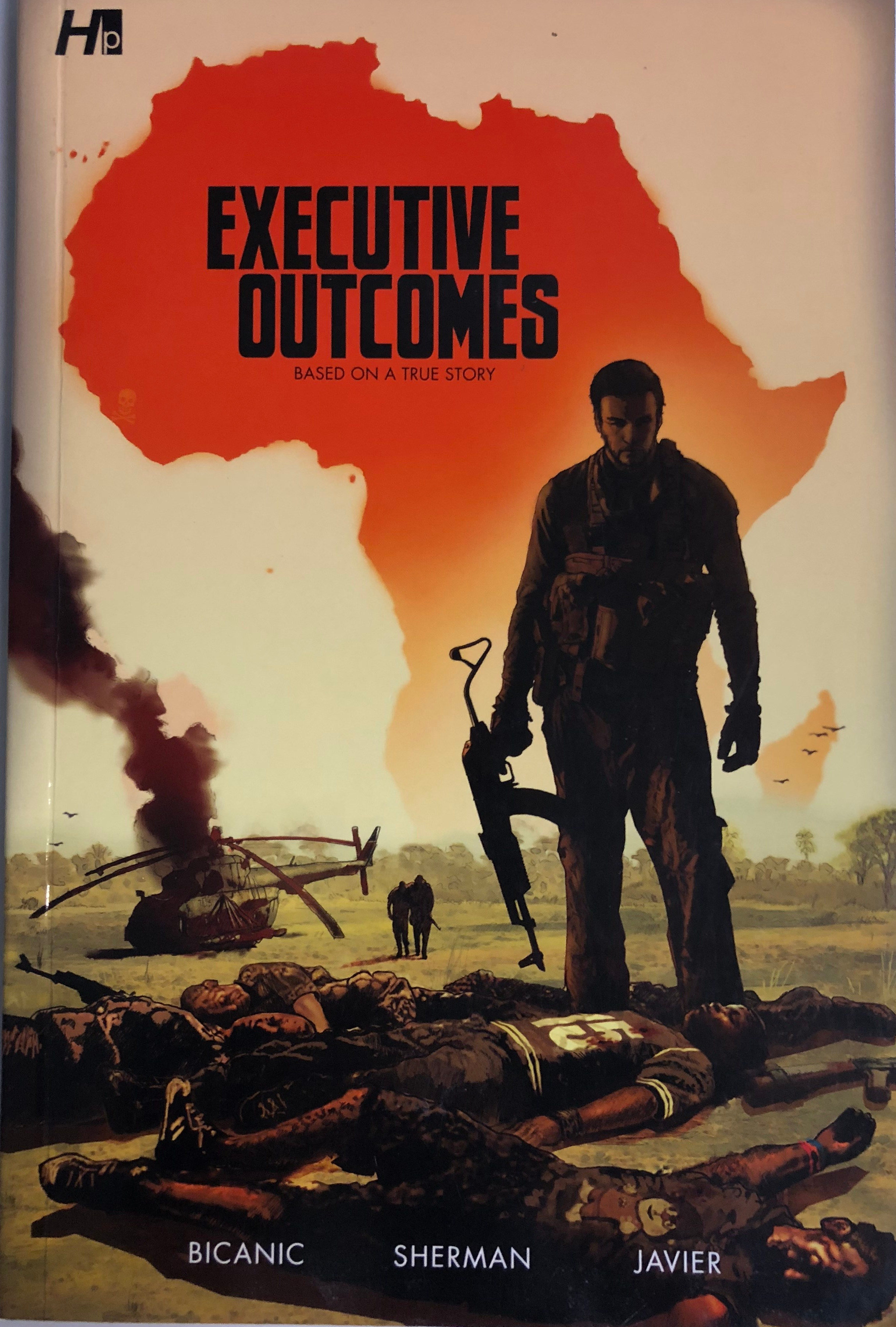
“In the early 1990s, the small West African country of Sierra Leone was a gruesome war zone. Over 15,000 rebels roamed the countryside raping, pillaging and brutally murdering everyone in their path. The under-trained and unmotivated Sierra Leone Army was powerless to stop them. As the rebels advanced towards the country’s capital, the world held its collective breath… Genocide was imminent.
In a desperate attempt to save hundreds of thousands of innocent lives, the government hired the infamous private military company, Executive Outcomes, to quell the tide of blood.” CAPTION: By Nick Bicanic PHOTO: Leri Greer Courtesy of Hermes Press
Francis: Fine, thank you. Yes, I am from Freetown. Why is Bloodsong so expensive?
Jim: Bloodsong went out of print in 2003, when Harper Collins sold off its military history division. The book is now a collector’s item. The paperback edition is better than the hardback because it includes EO’s Sierra Leone contract. The hardback covers only EO’s contract in Angola. I have no control over the prices, nor do I receive royalties from second-hand sales. The best site for finding rare books is http://www.abebooks.com.
It is fortunate you left the country before Foday Sankoh returned from Libya and started the Revolutionary United Front( RUF.) I interviewed a few RUF prisoners and was sickened by the atrocities they committed. Strasser had already been sent to Conakry when I was embedded with EO, but I met the rest of the National Provisional Ruling Council (NPRC.) They reminded me of teenagers having a party with no adult supervision.
The most impressive man I met was Chief Sam Hinga Norman. He was a gentleman who exuded the charisma of natural leadership and was instrumental in forging the alliance between EO and the Kamajors. When the Kamajors handed prisoners to EO for interrogation, they asked that they be returned because it was time to make a “rebel stew.”
Francis: You are not suggesting cannibalism was practiced in SierraLeone are you?
Jim: Ritual cannibalism is common throughout West Africa. When Liberia’s President Samuel Doe was captured, a video was made of him being tortured, he was beaten and his ears were cut off. Watching and giving orders was Charles Taylor’s second in command, American-educated Prince Johnson. The last word from the video came from Johnson, who says, “Turn off the video it’s time to eat.” Doe was the meal.
Before EO arrived in Sierra Leone, American mercenary Bob MacKenzie was killed and eaten by Foday Sankoh and his senior advisors. My friend Fred Marafono told me that the Kamajors often cooked and ate RUF prisoners, in the belief that it gave them magical powers.
But it is not just in West Africa. Today, albinos are protected by some NGOs in Tanzania, to save them from being murdered and parts of them sold by Sangomas to cure different diseases. The same happens even in South Africa where it is called “muti magic,” which is thought by some to cure AIDS. The primary source of this muti magic are refugees from Zimbabwe and Mozambique. The most expensive muti is the genitals from baby boys.
You might ask your Nigerian friend if it happens in his country.
If you explain this to good American progressives they will never believe it.
One of the EO men was a Fijian by the name of Fred Marafono, who was adopted as a brother by the Kamajors. His book, From SAS to Blood Diamond Wars, is an interesting tale. With my permission, he used a number of my photos, including one on the cover.
EO’s founder Eeben Barlow also wrote a book about his company in Angola and Sierra Leone. The title is, Against All Odds.
Soldier of Fortune was one of about 20 more serious magazines to publish that piece.
Just to be clear, I am a professional writer and hold the copyright on all my photos and published words. I paid all my expenses and suffered a lot of discomforts to get the material for my articles. As a result, I take a very dim view of anyone using more than about 50 of my words in anything they put together.
Jim Hooper It takes a special guy to be where death is ever-present and vultures wait in the sky to feed on dead bodies
“The local Sierra Leonean battalion commander whose troops would be taking part was snoring gently. Colonel Hugo’s pointer tapped the map: The first Sierra Leonean infantry company would advance from the north towards the rebel-held town of Gandorhun. With the infantry and support elements in place, Nigerian air force Alpha jets would bomb the town, followed by the Mi-24 gunship using rockets and AGS 30mm grenade launcher pods.” Jim Hooper- Soldier of Fortune Magazine August 1996
Francis: Why did you choose to live in London, England?
Jim: When I made the decision to become a war correspondent, I asked a friend who was a Reuters bureau chief, where was the best place to start. “Africa,” he said.”Plenty of small wars.” But then he added that there was no market for Africa in America. But the UK and Europe were usually interested because of their colonial history.
I’d already visited England a few times for international parachuting conferences and liked it. (It was also a lot closer to Africa than the states.) I packed up all my worldly possessions and moved here in 1984.
Francis:These are all facts right?
Jim: You came to me for help about Executive Outcomes in Sierra Leone. I was with them in Freetown, Koidu and Gandorhun. I also rode in helicopter gunships flown by Russian mercenaries supporting EO. If you choose not to believe any of my first-hand observations in Sierra Leone or any other place in Africa, that’s your right. You may even believe that whites are responsible for all the problems in the continent. You may also be convinced that all the problems African-Americans have today, is the result of slavery – an institution that was abolished by whites 154 years ago.
How many post-emancipation generations must pass before that excuse wears so thin it has to be kept in a hermetically sealed glass case in the National Archives? But here is another indisputable fact: You are welcome to use whatever second-hand politically- correct sources you want. I really don’t give a damn.
Francis: I was born in Sierra Leone and have been to every nook and corner. Never heard or seen anything like what you are saying. Must be one of the vagaries of war.
Jim: C’mon. It doesn’t mean ritual cannibalism is practiced by every tribe or ethnic group in West Africa, merely that it exists in most of them. (As well as eastern and southern Africa- as it is in Papua, New Guinea.)
I have better things to do than debate with defensive and argumentative people. If someone asks me about my experiences in various parts of the world, I usually try to help. But if they say, “you’re wrong, you don’t know what you’re talking about,” they’ve used up all the time I’m prepared to give. Better if they look elsewhere for help.
I don’t care what you write, unless you quote me out of context, to say something that is at odds with the original meaning of my words. It happened a couple of times. The consequences were, using my membership in the Society of Authors to explain the downside of their actions.
Jim: I can think of no reason why anyone needs to see a photo of me. It certainly wouldn’t help book sales. In fact, because there is nothing remotely politically correct about my work, your readership would probably be offended by it. (How dare he say that white South Africans and black Namibians fought shoulder to shoulder as brothers in arms during the apartheid era! It’s a lie!)
Francis: How about war-action photos?
Jim: After talking with the photo agency that syndicates my work, I was reminded of the contract I signed with them, which stipulates that they have all syndication rights. The way it works is that a query may arrive from someone somewhere. “Do you have any stock images of this or that?” My agency is owned by a bigger agency in Paris. So the London end charges say, 150 pounds sterling. Half of that goes to Paris, which in turn pays me half of what it receives from London.
The rationale is that before digital cameras were the norm – all my stuff was shot with wet film – they had to make dozens of copies to send to agencies around the world. Quite understandably, they want to recoup their investment and make a profit.
It’s the same with book publishers; the standard industry-wide contract prevents an author from selling his own book. The reason is that the publishing house has invested in proofreading, book design, printing and binding, promotion, distribution, shipping, and warehousing.
After that come the discounts to big chains like Daltons (50%) and, of course, Amazon, which gets a 66% discount. Their last expense is my royalty. From the retail price you see on a book, the author gets ten to twelve percent. You can see why Kindle is popular with them; when paper sales start to trail off, it costs about $500 to digitally format the book, and once that’s done there are no printing, binding, distribution or warehouse costs. Not so good for the author, however.
Photo agencies and publishers inhabit their own arcane world that’s little understood by folks outside it.
Francis: You spent a lot of time in Africa, especially southern Africa. Here in America, we have to deal with racism. In Africa, tribalism is prevalent. Did you encounter racial discrimination?
Jim: Tribalism is just a polite euphemism for racism. The best-known example being between the Tutsi and Hutu in Rwanda. (They each have certain physical characteristics that allow one side to identify the other). In Kenya, it is between the Kikuyu and Luo. In Sudan, it is between the Dinka and the Nuer. In South Africa, it is between the Zulu and Xhosa. In each case, one side sees the other as racially/culturally different and inferior.
In Sudan, I think the light-skinned Muslim Arabs and black Muslims use the same derogatory word for southern blacks, which is “abd,” the Arabic word for slave.
A friend in Nigeria, Takumbo King, is a British-educated lawyer and has a very successful legal practice in Lagos. King is not the name picked from some brutal overseer, but a name that an ancestor chose to identify himself as paramount chief of the largest coastal tribe.
Takumbo inherited the chieftainship. He happily admits that his family got his wealth and prestige as a result of his great-great-great-great-grandfather selling prisoners captured in the war to European slave traders. Over a couple of beers, he shook his head and said, “why do blacks in America always blame you whites for slavery? We have slaves centuries before whites arrived!”
The same thing happened all along the west coast of Africa -Sierra Leone included. You may be descended from slaves taken from Africa to America, whose children or grand-children were returned to Sierra Leone. You well know why Freetown got its name.
European and American slave traders never- never, sent hunting parties into the jungles. They did not know the terrain, the location of tribes or how to survive. Much easier and more practical to buy slaves from coastal chiefs. Why don’t blacks in America condemn the black Africans who sold their ancestors into slavery?
One of the reasons for the war in Sudan was Muslim slave traders capturing people from southern Sudan and selling them as slaves; this was happening until less than 12 years ago. A Christian NGO dedicated itself to raising money to buy them back and return them to their families in the south. Where was the African-American outrage over that?
You are well aware of how little your friends – both black and white – know about what happened in Sierra Leone. That’s because there is very little news about Africa, and also blacks killing blacks doesn’t fit the agenda of the media.
That said, I think we’ve exhausted the extent of our communication. I am so clearly misinformed that there’s nothing I have that you can use or trust. And that’s okay, your choice.
PS: Jim Hooper was a documentary research writer for WFLA- TV in Tampa Bay Florida. At some point during our conversation, we banged heads and he withdrew permission to publish this interview. We have since resolved our differences and he sent me the preface to his new book still in the works, as “a gift” (his words). Our communication lasted three days in July of 2017 before he shut me down. In January this year, it was resumed. I look forward to reading his new book upon completion. I know about Jim through tons of Soldier of Fortune magazine I used to read because of the war in Sierra Leone. It is now out of print. This is only an excerpt.
“For many people, war feels better than peace and hardship can be a great blessing and disasters are sometimes remembered more fondly than weddings or tropical vacations. Humans don’t mind duress, in fact, they thrive on it. What they mind is not feeling necessary.” Sebastian Junger
Diana Jill Moxhay, 74 PEAKS ISLAND – Diana Jill Moxhay, a resident of Peaks Island for the past decade, passed away gracefully on Saturday, May 21, 2016, at her home, surrounded by family, following a brave battle with cancer.
Diana Jill Moxhay Credit: Legacy.com
Born on March 17,1942, in Rye, N.Y., she was the daughter of Jack and Dorothea Moxhay. A 1960 graduate of Rye High school, she matriculated to Smith College in Northhampton, Mass., and in 1964 became the first member of her family to graduate from college. Diana possessed a competitive spirit and participated in sports, particularly lacrosse, throughout her school years, in an age when that was far from the norm for young women.
Following college, she worked for Radio Liberty Munich and Voice of America, soon being recruited by the State Department’s Foreign Service. Diana had a fantastic facility for language, speaking half a dozen comfortably; but her greatest passion was for Russian, which she began to learn while at Smith to better understand and enjoy the works of Dostoevsky and other Russian authors in their native tongue.
In 1971, Diana became the first female Foreign Service officer posted to the American embassy in Moscow. Her mission there focused on creating a deeper cultural understanding between the two great superpowers, long before official relations began to thaw.
Over the next three decades, Diana was posted in Chile, Cameroon, Sierra Leone, Somalia, Russia again, Belarus, and Austria, reaching the most senior levels of the Foreign Service. Her professional life was spent confronting historic forces like the Cold War and colonialism and shaping the world that was to come following their collapse. She not only had a front row seat to history, but she was a direct participant in it, and in her retirement would casually recount her interactions with presidents and dictators.
Diana seated, arms folded at the American embassy in Freetown Sierra Leone- 1985
Ever a champion of democracy and free speech, Diana took particular delight in having incurred the personal ire of despots like Vladimir Putin, and Alexandra Lukashenko, both of whom eventually barred her from entering their countries, resentful of her work to empower the free press.
In spite of her proletarian loyalties, Diana was a woman of impeccably refined taste, with the deep appreciation for an encyclopedic knowledge of classical music, opera, ballet, and fine arts and was personal friends with numerous prominent Russian dancers, artists, and musicians.
Having spent the majority of her life fighting for ideals and enabling high-level diplomacy in every corner of the globe, Diana designed and retired to a beautiful home overlooking the sea on Peaks Island, where she could finally be close to family and enjoy a wonderful community. Diana is survived by her brother David, his wife Judy; her brother Peter, his wife Kathryn and their children Olwyn, Imogen and Nikolai; her nephew Christopher, his wife Bonnie; and her cousin Gregg, his wife Hazel
An exclusive with Dr. Wilson Ingram at the old American embassy on Walpole Street in Freetown Sierra Leone facilitated by Diana. Dr. Ingram was in Freetown to address the Sierra Leone Bar Association (1985)
PS: I was in my office at The Globe newspaper on 40 Rawdon Street in Freetown, the same building that used to house The Tablet Newspaper, when Diana popped in and invited me to the American embassy. As a champion of the free press, she was captivated by the paper’s output. One that was independent, in a one-party state, headed by Siaka Stevens, the president then. Stevens had turned his back on America to stay in power for life. He became friends with China. China built a national stadium, Youyi building for the government ministries and a new city hall in the city of Freetown.
One of his stalwarts (name withheld) had burned the American flag in public. Medical doctors were now trained in Russia and Cuba. Lada cars – Russian made vehicles were aplenty on the streets of Freetown. Stevens’ personal security unit, the notorious Special Security Division (SSD) were trained in Cuba.
I became a regular face at the embassy. Ray Pardon and Arthur Lewis ( U.S. ambassador and wife Fay), became my friends also. So began our relationship which was to blossom into a close but professional and platonic one.
One day I went to the embassy, and Diana said to me, “Francis, there is a vacancy at VOA to report from Freetown and the bureau chief Sonja Pace( based in Abidjan Ivory Coast) will be here. You will be a good fit for it” The former VOA reporter Royston Wright(blessed memory) had just died of cardiac arrest in his early 40s.
Sonja( pronounced Sonia) was in town to cover the change of guard. Stevens was an octogenarian and was getting tired of ruling. He wanted to hand over power to his hand-picked successor.
Joseph Momoh, Stevens’ hand-picked successor outside Youyi building(built by the Chinese) unveiling the bust of his predecessor. (1985) If you are a Sierra Leonean, you know how he was removed from power. The current president had a hand in it. (A coup)
At the first press conference, following Stevens’ retirement, I was able to sit next to Sonja because I.B. Kargbo an influential journalist turned politician lately had put me in charge of the conference arrangements. I had left the Globe because of editorial disagreements and moved over to I.B.’s New Citizen newspaper, whom I had worked with at the Tablet, and we were friends. At this time, we did not share the same convictions anymore but was too annoyed to stay at The Globe and I have never been interested in politics. Also by then one of the key writers I relied on, Kortor Kamara had left for the U.S. And I.B. treated me with respect. God bless him and Ms. Daisy Bona.
After I expressed my interest in the job, Sonja asked that I send her 30 lines(correspondent’s report distinct from news advisory which is 10 lines) on the ceremony that preceded the press conference. I dropped my story at the front desk of the Brookfields hotel where she stayed. The next day she called me saying, “I like your style of writing. How would you like to work for us? We cannot guarantee your safety, but if you are arrested, we will put pressure on the government for your release.” she went on.
Now, go figure the state of the press in Sierra Leone then. It was a dangerous job for which my mom had given up on me saying I was committing suicide.
So, I was American, before I became an American citizen. I was called a CIA agent and worse names. America gave me a job when my country of origin had denied my application to own my own newspaper. The Globe was not mine. I left Sierra Leone, and I have never looked back. I still love the country, my country?
OK, this is about Diana, not me. I believe you get it. I was about to write on race in America when she came to mind. That was when I found out she passed away two years ago. I contacted the newspaper on Peaks Island, where she spent her last few days, sent them a photo of Diana with words of condolence from my family and me as proof of our friendship and they sent me this beautiful piece. May Diana’s soul rest in perfect peace.
They came from far-flung countries such as Peru in South America and close, from Canada up North. They are Indians. The majority of them are descendants of Native Indian Americans who had inhabited this beautiful land long before anyone else set foot here.
It is estimated that there are over 500 Native American tribes or nations, the preferred designate, in the United States of America. They converged en masse on Traders’ Village in Grand Prairie Texas this past weekend to celebrate their heritage. A Pow Wow it was.
Arrived early on this hot Saturday morning before it was crowded (Grand Prairie Texas)
There were the Mohawks, original inhabitants of parts of New York, recognized by a hairstyle which leaves a strip of distinct hair in the center while both sides of the head are shaven.
The Inkas, great musicians, were in attendance with their melodious Pan Flutes, consisting of several pipes of various lengths tied together. Oh, they sound great!
Listen to Antonio an Inka from Lima Peru, play the Pan Flute at his stall- Traders’ Village Texas above. He is a brilliant guitar player as well. He told me, “you speak good English,” to which I cockily replied, “of course.” I once used the word “COCKSURE” expressing how confident I was about the numbers in my report my boss at work had labeled “JACKED UP”, in an email. To have inadvertently separated the word COCKSURE in two did not help and I was reprimanded by a man who thought college is a waste of time.
Different nations have different flutes used for different reasons. Entertainment and spirit-calling make the list.
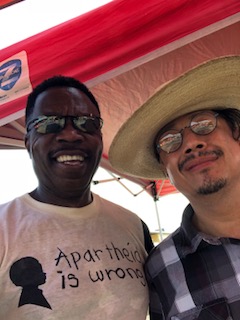
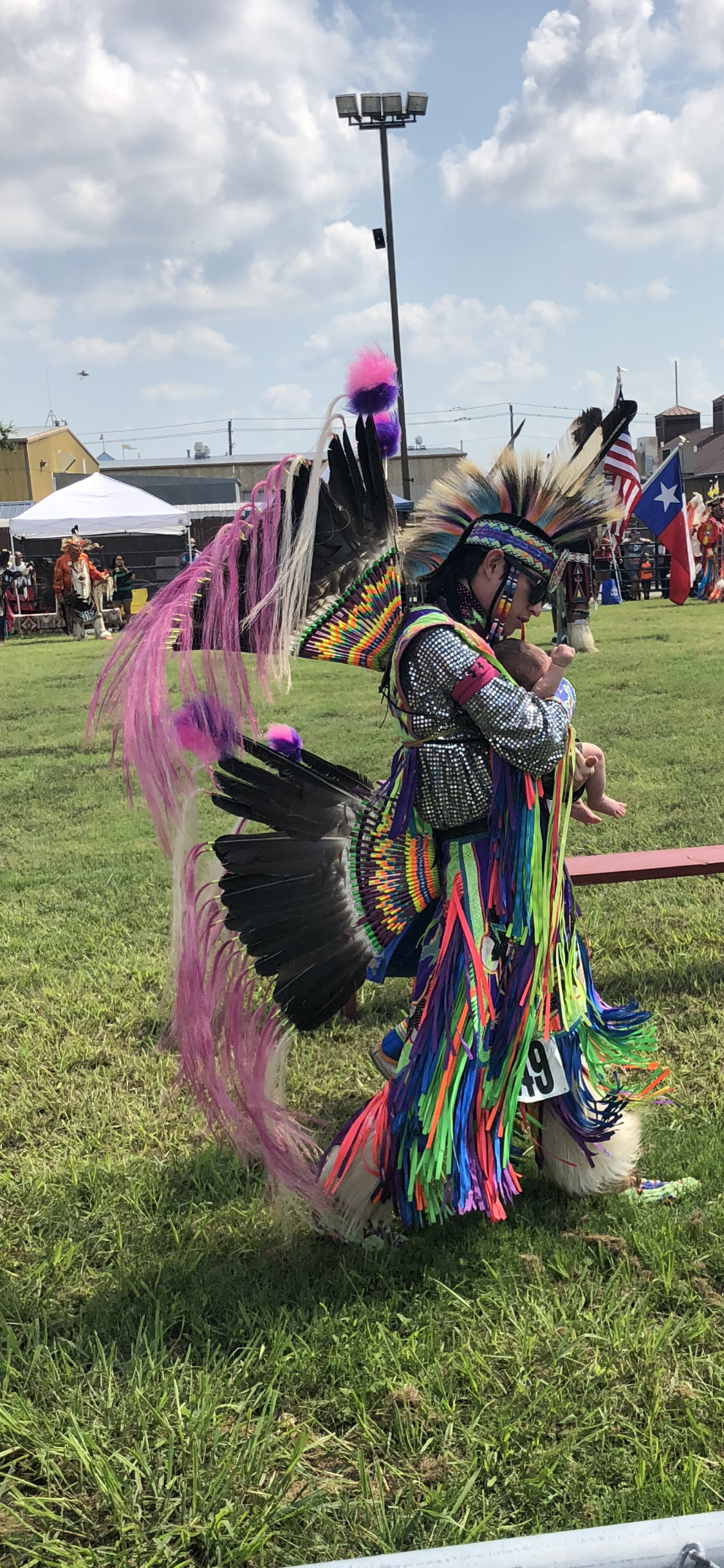
They were very colorful, neat and a pleasure to see. Without a doubt, their outfits of feathers, animal hides, plants of weaving thread display their ingenuity. They were resplendent. Some asked for $5 a pop to take pictures with them, which I declined to do. So I merely inched away and used my iPhone X to take a selfie, with them in the background.
A Native American in Ray Ban sunglasses carrying her baby Sunday(Grand Prairie Texas)
After all, I was spending a lot of money to eat, drink, park, purchase merchandise and pay for a rental car for three days.
Traders’ Village is replete with as many ATMs as there are knockoffs, bootlegs. Transactions are mainly in cash with no refunds or returns. It is a neat place with clean restrooms, and the grounds are littered with visible trash cans.
There are rides for kids as in Six Flags of Texas, a food court, beer stalls and plenty of anything to buy.
They filed in one-by-one onto the stadium-like grounds for the celebration led by two, raising the Stars and Stripes and the Lone Star flags. The chief in charge said a prayer. When it was time for the national anthem, I was standing at ease, shooting videos and taking pictures, so I had to stand at attention for the Star Spangled Banner. Or so I thought. What I heard blew my mind. Native Americans have their own national anthem.
There were no other flags of their own worthy of note so without asking, my conclusion was since they only had two flags, they stood for the U.S. national anthem when played, which was not sung.
Speaking to the audience, the chief admonished the crowd not to read history books about Native Americans. “Do not read the history books about us. They were not written by us,” he said.
It sounded like a tacit castigation of Christopher Columbus who is thought to have discovered America.
“Columbus didn’t discover America – he never set foot in North America. During four separate trips that started with the one in 1492, Columbus landed on various Caribbean islands that are now the Bahamas as well as the island later called Hispaniola. He also explored the Central and South American coast. But he didn’t reach North America which of course was inhabited by Native Americans.” Valrie Strauss- The Washington Post.
Not to be outdone, Jamaicans had long ago taken swipes at Columbus. Listen to reggae star Burning Spear.
They danced in a circle, chanting what was not understandable to me because I could speak none of their languages despite I frequent Oklahoma, officially known as Native America.
The sign in Oklahoma when you cross the Red River which forms the border between Texas and Oklahoma on highway 75N
On one of my trips to Oklahoma, I met Juanita, a twin, at a gas station in Glenpool. “You are Native American, are you not?” I asked. “Yes,” she replied and hastily added, “but I cannot prove it.” Juanita is Choctaw. Texas Oklahoma border is Choctaw nation country but she was in Creek nation area in Glenpool, two and a half hours away from home. To get to Creek nation from Texas, you go through Caddo and Kiowa nations.
During this weekend’s celebration, embedded in the group was a black guy who ostensibly has been able to establish his Native American heritage and is perhaps enjoying the attendant benefits.
An African American of Native American descent (Grand Prairie Texas)
Gee! How could he succeed in getting accepted when Juanita and her sister could not? Well, It is none of my business and I believe in science and history so I continued to enjoy the show, knowing many Americans have been unable to do the same.
On Monday, October 8, 2018, America celebrates Columbus Day. For now, dance to this Inka music which got me pounding the floor with my feet all night when I got back home Sunday.
Credit: The videos of these Inka musicians, Burning Spear, and the Native American National Anthem are from YouTube.
Outside Interabang Books the rush hour traffic has died down. A few motorists weave their way through the well-lit Dallas shopping center parking lot hoping to find a space. Inside, visitors are greeted by the pleasant scent of fresh timber and books. A couple of dozen brand-new books are stacked right in front by the register to buy and get autographed.
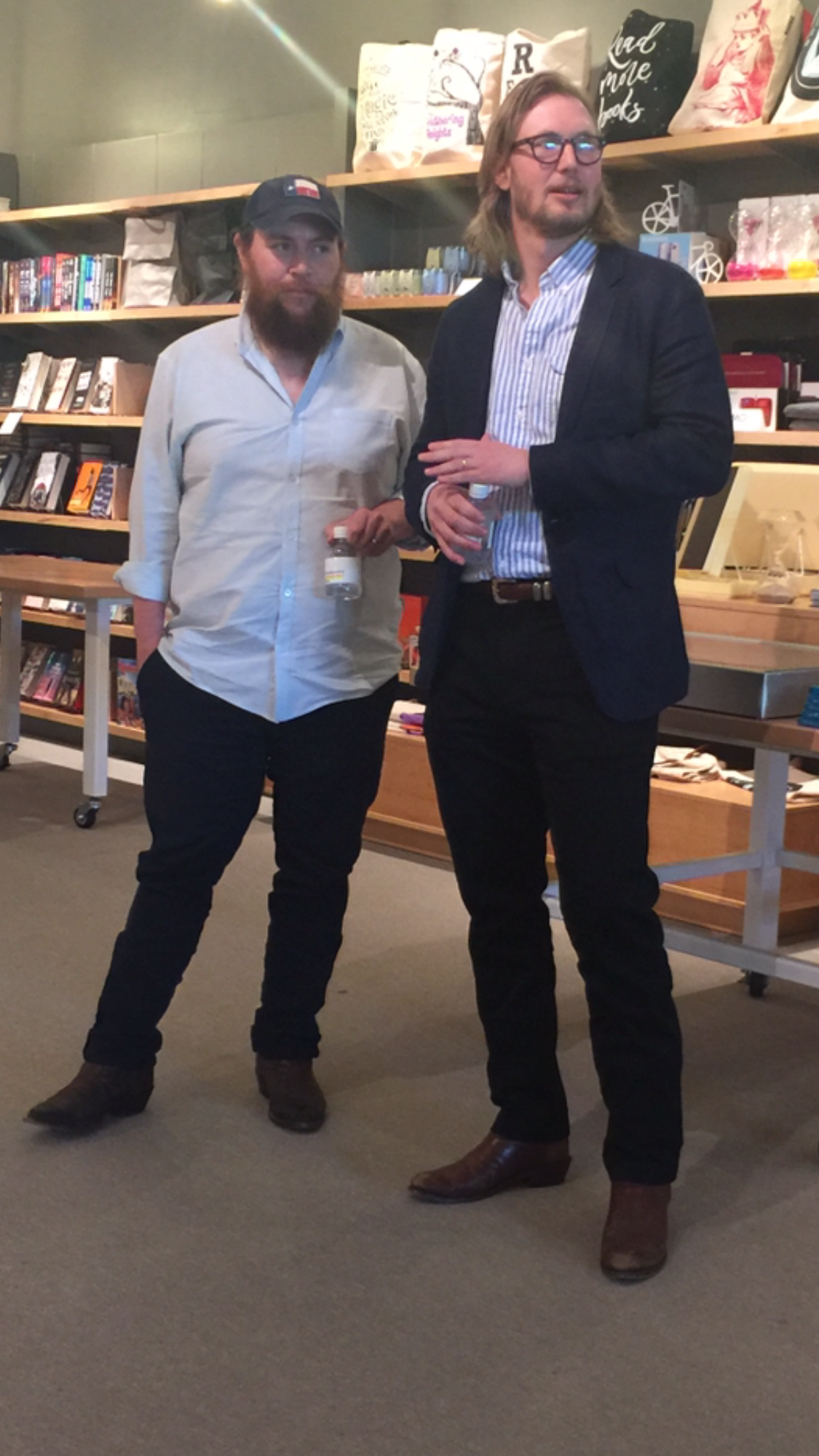
The customers make their way to rows of folding chairs laid out just for this evening. In front of them are two chairs on a makeshift stage. One is for Brantley Hargrove. In the other is his fellow author Michael J. Mooney, microphone in hand, ready to kick off the launch of Brantley’s new book.
Mike Mooney (in cap) and Brantley Hargrove at Interabang
Hargrove’s expressive bright eyes behind his reading glasses betray no nervousness.
Instead, he beams a relaxed smile, clearly enjoying this moment celebrating the release of his book, two years in the making.
Mooney introduces his close friend and requests, “Give us a brief overview of who this person is.”
“He is one of the most prominent storm chasers in America for a few reasons, but probably is best known for getting data that research meteorologists thought was impossible,” Hargrove replies.
“What was he like as a kid? What makes somebody one of the great tornado chasers?”Mooney went on.
“He was always taking his mom’s appliances apart. I think he took her television apart at about age 12,” says Hargrove, explaining Samaras’ curiosity at an early age, which was to evolve into becoming a storm chaser.
Beautiful clouds over the memorial park on County Road 305 and Double Creek Drive in Jarrell Texas, the path of the 1997 tornado where 27 people just vanished. They perished in their obliterated homes. “To this day, the Jarrell Tornado remains unparalleled, and the damage it caused is easily the most intense ever documented. This tornado blew some houses completely off the foundations and swept away the disintegrated remains. It also scoured asphalt from roads, killed and dismembered hundreds of cattle, stripped bark from trees and uprooted them and bounced vehicles for up to half a mile from their parking places.”
As Hargrove goes on, the audience listens attentively, interjecting with laughter,
exclamations of awe and murmurs of appreciation throughout his talk. Then Hargrove shows a few video clips of storms he witnessed.
Violent and destructive whirlwinds, some with speeds of over 200 miles an hour and accompanied by funnel-shaped clouds, heavy rain and thunder fill the large television monitor. The sound of roaring wind comes out of the speaker and then,
in a few minutes, almost as quickly as it started, it was all over. The uncomfortably deafening noise of a tornado abruptly falls into silence.
After further describing Samaras’ contributions to the science of tornadoes, Hargrove opened the floor to questions from the audience. One customer wanted to know what wind brings buildings down while another was curious about what happened in El Reno in 2013.
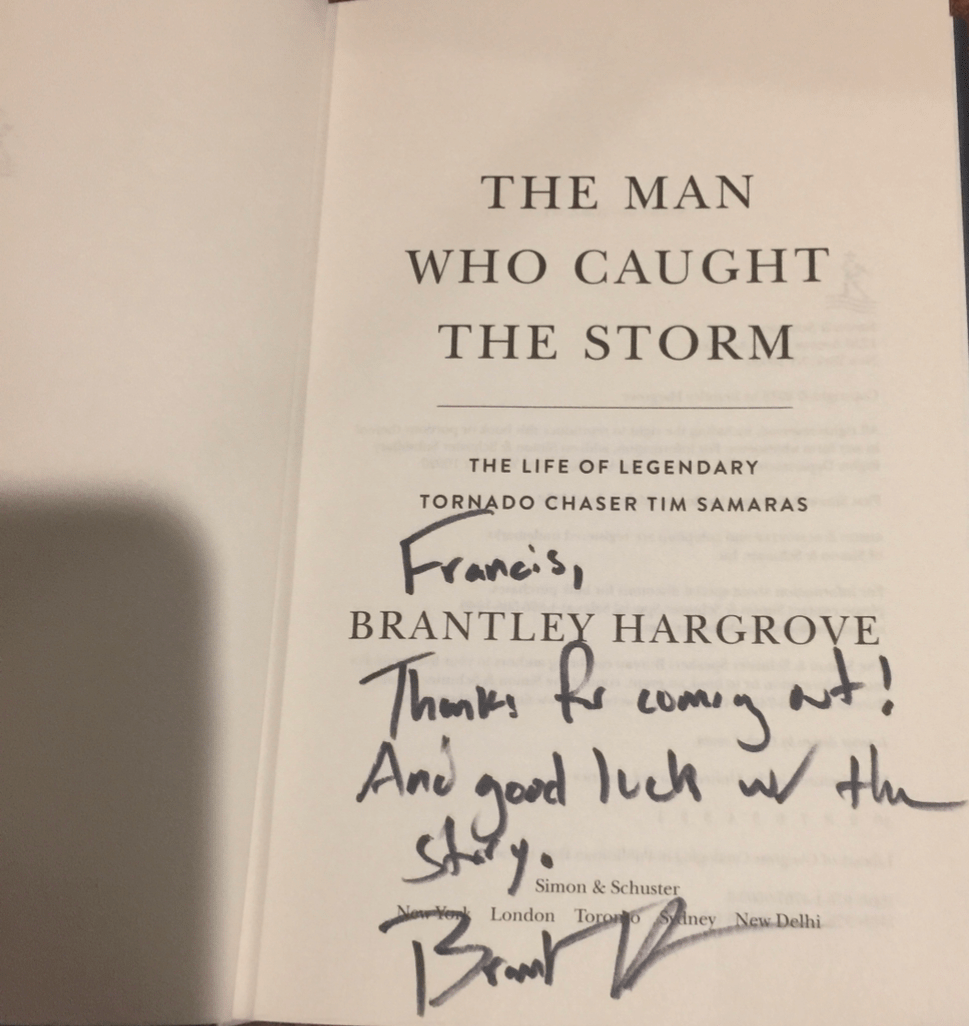
As the hour-long launch was coming to an end, customers lined up on one side of the store with books, patiently yet eager to have Hargrove append his signature to their new purchases. Turning to the title page, he writes a personal message in each. Mine read,“Francis, thanks for coming out and good luck with the story.”
Several from the audience posed for photos with Hargrove after they collected his signature.
Hargrove is the first to admit that his object of labor is far from exhaustive on the topic of tornadoes and its science. But on this night, he was able to introduce his contribution to understanding a frightening and overpowering natural phenomenon still shrouded in mystery in the form of a compelling story about a self-taught man obsessed with pulling back the veil.
Interabang Books was all too happy to host a first book launch for a local author. According to the store, sales on this night were “brisk.”
It was a good night.
A storm shelter in the backyard of a home on County Road 305, Jarrell Texas.
PS: Tornadoes on average kill about 64 people each year in the U.S., but in April 2011, over 300 people were killed. That’s just in one day. Read the complete story on the author in the 2018 Mayborn Magazine out tomorrow. Better still, why not buy his book and marvel at an autodidactic (Samaras) who did what top-notch scientists could not.
Our criminal justice system is made up of the police, courts, and corrections. The police issue citations or make arrests where applicable and those arrested are given due process. They are brought to court where they can be tried by a jury or a judge who decides what the punishments will be.
If the arrestee is found guilty by the courts and the punishment determined is a jail term, then the culprit gets to do time for being found guilty of a criminal offense. The public often understands that you do the crime, you do time.
However, all across America, there has been a staggering number of citizens arrested, tried by the courts and sent to jail for something they never did. So, how is it that it is not uncommon to not do the crime, but you have to do time?
American citizens have been increasingly incarcerated for crimes they never committed. They spend large chunks of their lives behind bars for something they did not do, and it is hard to believe that even after being found innocent and set free, the wrongfully convicted are never indeed set free because the baggage of prison time follows them everywhere they go.
It is even harder to get a job once you are released from prison because you have spent a lot of time locked up in one location while the world outside of you keeps changing fast. A lot of freed prisoners come out of jail, and they have to learn to use the internet to make job applications.
A relic of a pay phone outside a rinky-dink store in Denton Texas.
They will now need a digital resume, distinct from one on paper that used to obtain before they were locked up. There are no more pay phones, and very few landlines exist so they may have to purchase a cell phone. These and more render them almost useless to society immediately because they have to start life all over again.
Richard Miles of Dallas Texas is one of those freed not on DNA evidence but because exculpatory evidence was withheld from his attorney. He is doing ok. Asked what he went to jail for, his response was, “I am innocent.”
Mr. Richard Miles signs an autograph in his South Dallas office.
Those freed based on DNA evidence along with Mr. Miles spend on average more than 14 years behind bars according to the Innocence Project. The pain and grief of life in prison exacerbated by the total loss of freedom, locked away for years away from friends and family gets only worse after release that provides no apology, compensation or rehabilitation.
Even though these people have been proven innocent and cleared of all wrongdoing, with nothing to start their new life, their punishment continues unabated, many years after their release and reentry into society.
While 29 states and the District of Columbia have compensation laws, many are inadequate regarding getting them back on their feet. Texas’ is, however, one of the best and it is tempting to believe it is because we have the most exonerees.
The number of wrongfully convicted has been on the rise for quite some time now. In the 2016 year, according to the National Registry of Exonerations, there were 166 people freed nationwide, who had been convicted of crimes they did not commit.
To be locked up for a crime you did not commit is one thing. But after the wrongfully convicted are freed, they face a multitude of challenges ranging from lack of jobs to housing and health insurance. Which is why while exonerees look to restart their lives upon reentry into society, they eagerly look forward to some financial compensation to give them some cushion as they rebuild their lives.
Jimmie C. Gardner spent 26 years, of a 110-year sentence in a West Virginia prison, all the time fending off aggressive inmates in a bid to remain alive. Prison is a different world where fights often break out. But after he was released last year, he was faced with another conflict. Now out of prison, he had to fight to get compensation for doing time when he did no crime.
It is incredible how Gardner was not a bitter man at all after he was set free. How do people spend decades behind bars for crimes they did not commit and come out smiling?
Here in Texas, it took six letters to the Dallas County court, for an exoneree seeking post-conviction DNA testing that will clear him for the crime he did not commit but had spent 25 years in prison. That was one of his fights in jail. Once out, he had also to fight to get compensated, and that will take some more years.
Johnnie Lindsey spent 26 years in a Texas State Penitentiary for no crime, but after his release, he expected every penny for every minute spent behind bars. That was not to happen without a fight.
After a protracted legal battle, he won, and that decision paved the way to free up compensation for two other exonerees with circumstances not different from his. A testament to the fact that there is a second battle to be fought after prison time.
Dallas has been home to more than 40 exonerees. For most of these, a common thread runs through. Most of them fit the same type of description. Black and male.
Richard Miles of Dallas spent 15 years in prison. He was sentenced to 60 years for murder and attempted murder at 19 years of age. In an interview, he explained how it took him two and a half years to win complete exoneration and get compensated.
“What happens to a person accused falsely, then intentionally and wrongfully found guilty and locked up in a dangerous prison for something he did not do? How do you sleep at night, eat a meal given to you, you may not like, told when to go to bed, when to shower and what clothes to wear?” Miles asked.
One of his attorneys was professor and director of innovative education at UNT Dallas College of Law, Cheryl Wattley, winner of Oklahoma Book Award. Wattley, an opponent of the death penalty wonders why the notion of “if my son is not living, why should yours be,” still pervades our society, an apparent reference to Americans’ preference for the death penalty.
Professor Cheryl Elizabeth Brown Wattley
Mr. Miles is using his $1 million restitution, paid in lump sum and his monthly stipend of $5,900 to help those in similar circumstances such as his. He is plowing back this money in his non-profit organization, Miles of Freedom to help exonerees get settled down and find jobs.
It has mainly been the freed and compensated who have taken upon themselves to use what was given them rightfully, to help others who have suffered the same fate.
To date, the state of Texas has paid 101 men and women a total of $93 million in a 25-year period for wrongfully sending people to prison. A definite waste of taxpayers’ money when the courts should have had it right the first time. To err is human but to have 58 people wrongfully convicted freed in Texas last year is shocking would you not say? I am just saying.
In some of these cases, eyewitness misidentification has been responsible for sending these men to prison as in the case of Kirk Noble Bloodsworth in the state of Georgia.
The police sometimes also pressure suspects into owning crimes they did not commit.One such case was regarding the “Dixmoor Five” and “Englewood Four,” accused of rape based on false confessions.
A British Police Officer (Bobby), London, 2007
Regardless of the year and the time, the media have made it their business to take human rights abuses seriously and as such included it in their agenda every stretch of the way. Millions of people depend on news producers for information to navigate their lives.
The theory of Agenda-setting, which is the media’s selection of what to report and how it is reported has been well manifested in the coverage of American exonerees as more and more people get released from prison saying, I didn’t do it.
In 2016, African Americans, who constitute only 13 percent of the American population make up the majority of the innocent defendants. They are 47 percent of the 19,000 exonerees accounted for in the National Registry of Exonerees.
That Dallas had the most exonerees can be explained by the fact that the Dallas county chief law enforcement officer, the district attorney from 2007 to 2015 in the person of Craig Watkins was a black man.
He was fortunate to have met evidence dating back two decades saved at the time he took office.
Most of these exonerees are men who have been convicted of murder and sexual assault. Since 1989, 1,362 unjustly imprisoned people nationwide have been released.
Exonerees often find it hard to find work because their record may not be wiped out. Some cannot endure the pressure of an abrupt entrance into a world different from how they left it before they went to prison.
Since the death penalty, which is still on the books in most states is now sparingly used, putting so-called criminals away for long periods of time, have been the norm in states such as Texas and Oklahoma.
Long prison terms are now given preference because it is viewed as a death sentence, without an execution date.
Not all of these cases leading to freedom are as a result of DNA technology. Rightly, a lot of them were heard, and judgments were given before the advent of DNA technology, and it made an enormous difference. However, had the evidence not been saved over that period, some for over two decades, there would have been nothing to test.
So, evidence in all cases, especially ones where people are put away for a long time, should be kept for an extended period of time. How long? Dallas’ Craig Watkins suggests, if you are sent to prison for ten years, your evidence should be stored for 20 years. Twice as long.
Cases that were overturned not because of DNA evidence were due for the most part to prosecutorial misconduct such as withholding exculpatory evidence from the defense.
As for eyewitness evidence, that should be given little credence because most of the eyewitnesses in these cases recanted their stories.
Last year, seven inmates in Texas were put to death. In 2017, eight were scheduled to be killed, but only seven have been fulfilled. As we come to the close of the year, it is hoped that that number will remain seven suggesting that the business of putting our kind to sleep in Texas has plateaued. And that’s a vast improvement. Way to go Texas! Merry Christmas and a Happy New Year.
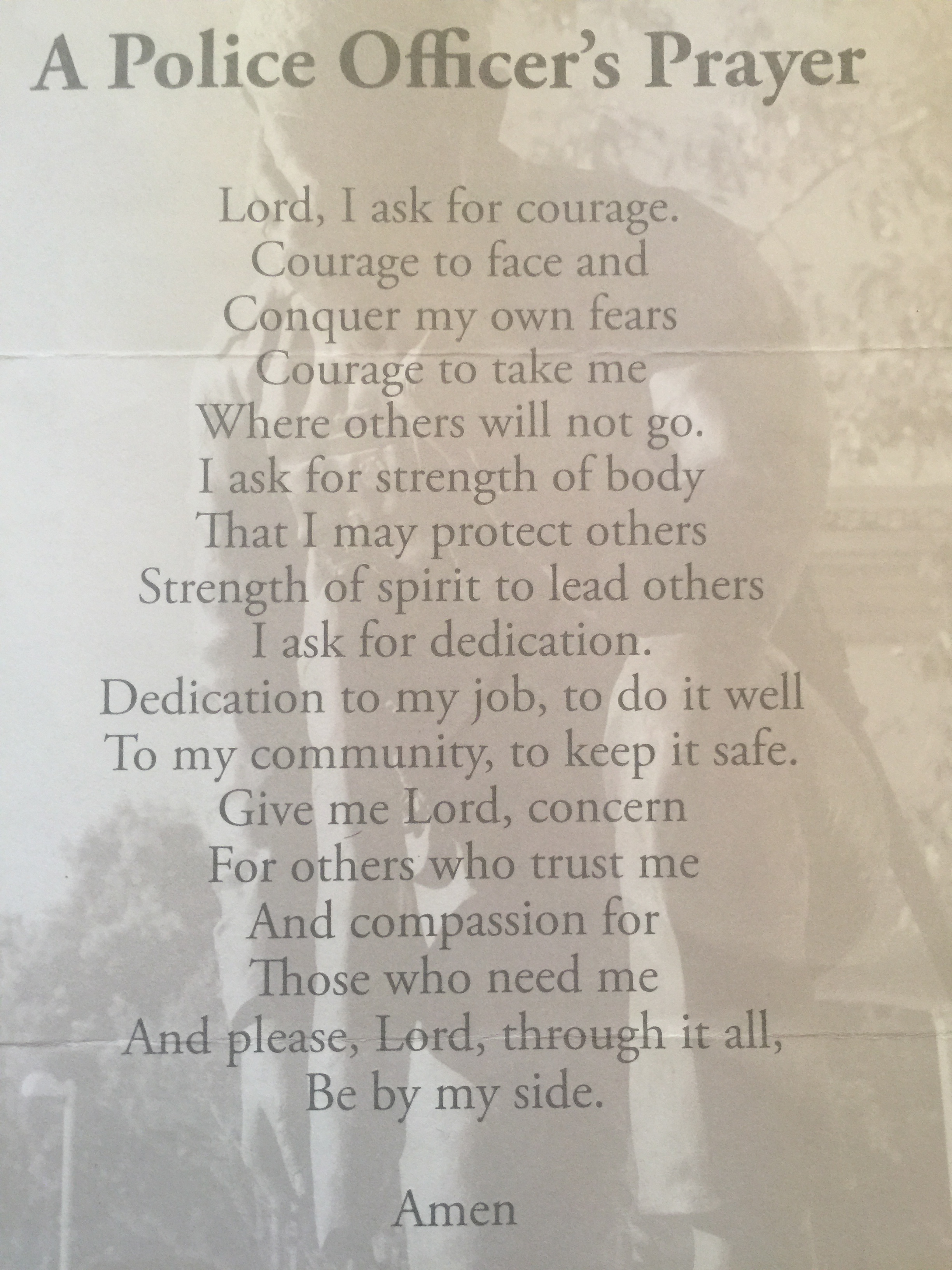
The flip side of a Plano Police Association’s correspondence bears this prayer.
PS: “Bobby” on the British policeman’s photo is a nickname. The genesis of modern policing is rooted in Pre-Victorian England. It was Sir Robert Peel, Home Secretary from 1778-1850 who created London’s systemized police force (The Metropolitan police). Bob is the short form for Robert, and the Brits gave his name to these group of men he so well organized-Bobbies.











 Francis Baldwin Deen